TUD017 Development of a contact-less propeller shaft bearing
Summary of the project
Ship propeller shafts are traditionally supported on oil-lubricated, so-called hydrodynamic bearings that are sealed from the marine environment using lip-seals or other mechanical contact sealing components. Below a critical speed these bearings and seals are operating in the mixed lubrication regime, where a fraction of the load is carried by mechanical contact with a significant resulting increase in friction and wear.
Traditional seals are not perfect, cannot be perfect. Leakage of oil out of the stern tube is forced, in order not to allow water to leak inside.
However, strict and ever increasing regulations are in place to prevent spillage of oil in a maritime environment. In order to accomplish this, the seals separating the bearing from the marine environment need to be ‘perfect’, no leakage allowed.
In this research we have developed concepts for significantly improved maritime bearings and seals with strongly reduced friction and wear and with zero leakage.
These concepts have been realized using magnetic fluids, i.e. ferrofluids and magnetorheological fluids. A new ferrofluid seal has been shown to have zero leakage and ‘infinite’ lifetime. Also, new magnetorheological bearings have been developed to realize full film lubrication at reduced shaft speeds, thereby reducing friction and wear.
Goal of the project
During this research new marine bearing / seal concepts or designs have been developed and tested, with the purpose of providing the maritime industry with a zero wear – zero friction – zero leakage solution for the propellor shaft.
The first two targets, zero wear and zero friction, have been accomplished by using a novel, robust magneto-rheological bearing design, the third target, zero leakage, by using ferro-fluids to seal the system without contact.
Both components of this new solution, the magneto-rheological bearing and the ferro-fluid bearing and seal are new for this application. Proof of concept has been provided
in small scale test setups and the technology is now being developed in a (close to) full size demonstrator by the industrial partner.
Motivation
Ship propeller shafts are usually supported on oil-lubricated, hydrodynamic operating bearings that are sealed from the environment using lip-seals or other mechanical contact sealing components.
In hydrodynamic operating bearings the shaft is supported on a thin lubricant layer that is maintained between the shaft and the bearing as a result of the relative speed between the two. At sufficient rotating speeds these bearings exhibit close to zero friction and wear. However, below a critical speed the bearing is operating in the mixed lubrication regime, where a fraction of the load is carried by mechanical contact with a significant resulting increase in friction and wear. During harbour manoeuvres and downstream inland shipping the bearings are regularly operating in this mixed lubrication regime. Mechanical contact seals are usually also working in that mixed lubrication regime.
Reduction of the mechanical contact in both bearings and seals will reduce the friction (and therefore fuel consumption) and wear (and therefore maintenance) of these components. In this research we have developed game changing new concepts for both the standard maritime bearing and seal, resulting in substantial steps towards a fully contact-less propeller shaft bearing-seal combination.
Of course, spillage of oil in a marine environment is not allowed, and strict and ever-increasing regulations are in place to prevent this. From harbour shipping, to inland shipping, to deep-sea shipping, all these sectors are expected in the near future to ensure zero leakage of oil. In order to accomplish this, the seals separating the bearing from the marine environment need to be ‘perfect’, no leakage allowed.
The use of water as a lubricant to replace oil seems a natural solution to this pollution threat and several manufacturers are now offering water lubricated bearings. However, due to the very low viscosity water is not very efficient in hydrodynamic operating bearings and seals, and current water lubricated bearings and seals tend to operate in the mixed lubrication regime, resulting in increased friction and wear.
Different solutions need to be developed, and we have developed some promising solution concepts in this research program.
Innovativeness
This research has resulted in innovative new design for ship propeller shaft bearings and seals, but also new mathematical and numerical methodologies to analyse magneto-rheological and ferrofluid seals and bearings to be used in high performance applications in high precision systems.
Valorisation
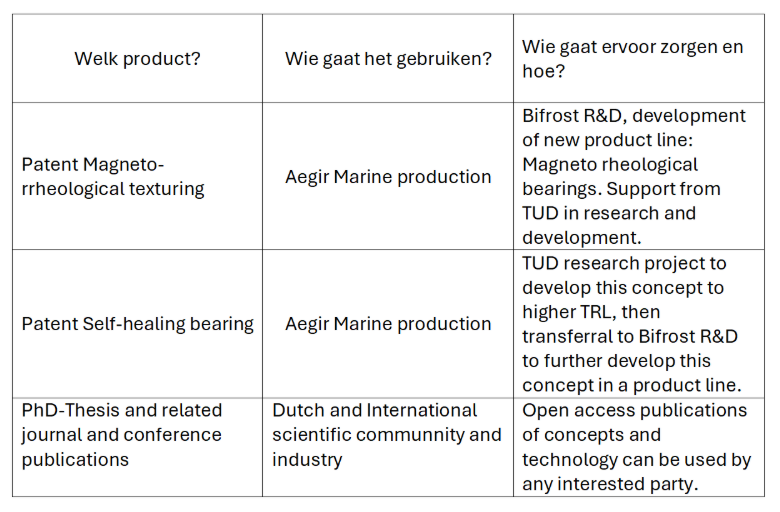
Duration of the project
Start date project 15-02-2021
End date project 31-03-2025